


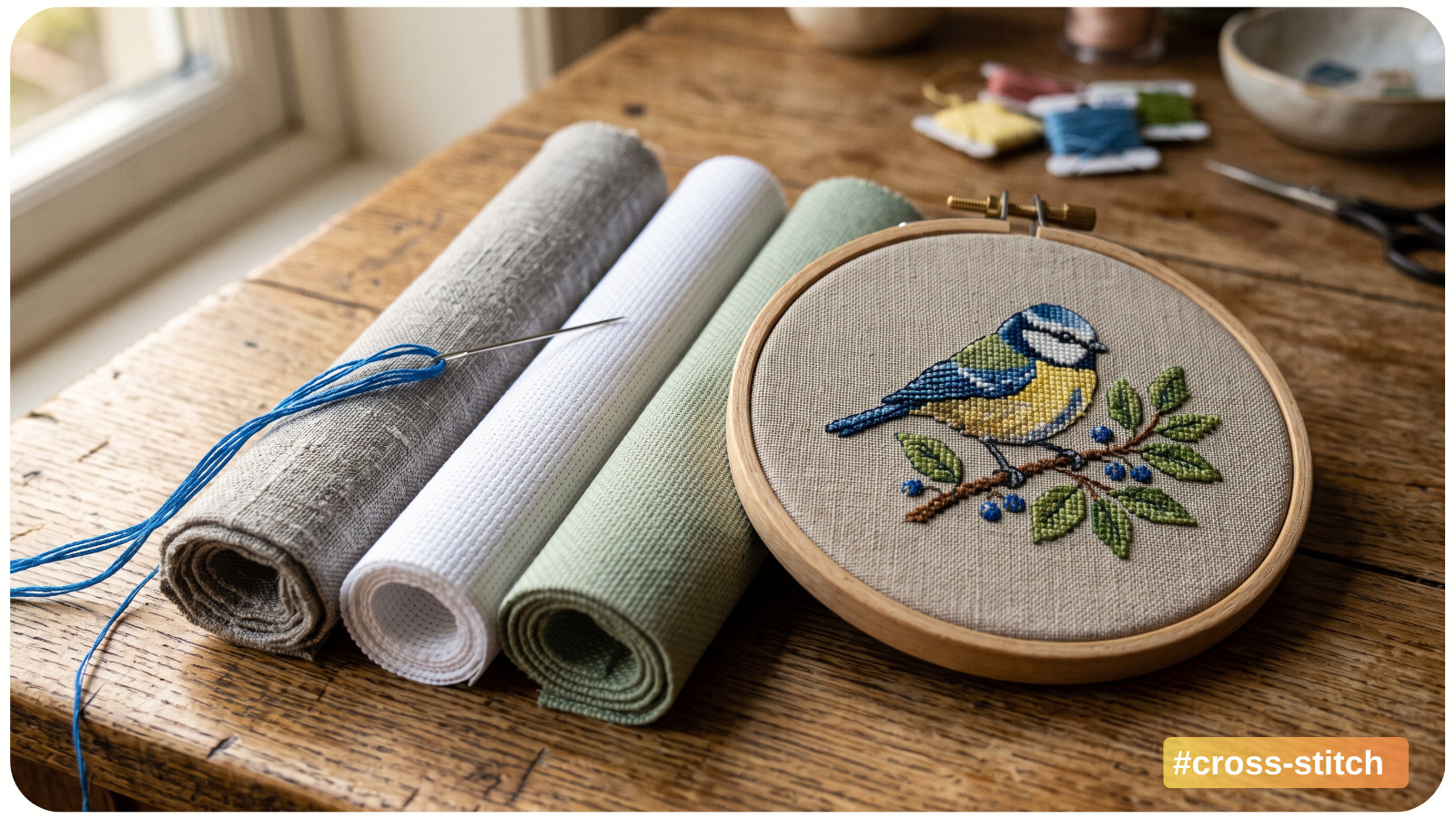
Cross-stitch fabric count tells you how many stitch spaces or fabric threads fit into one linear inch. A higher count creates smaller crosses and a smaller finished design. A lower count creates larger crosses and a larger finished design.
On Aida, count matches stitchable blocks per inch. On evenweave and linen, it describes fabric threads per inch, so the final stitch size depends on whether you stitch over one thread or over two.
This guide compares 11, 14, 16, 18, 25, and 28 count fabric so you can choose the right base before cutting or stitching.
What Does Fabric Count Mean in Cross Stitch?
Fabric count is the number of stitchable units within one inch of fabric.
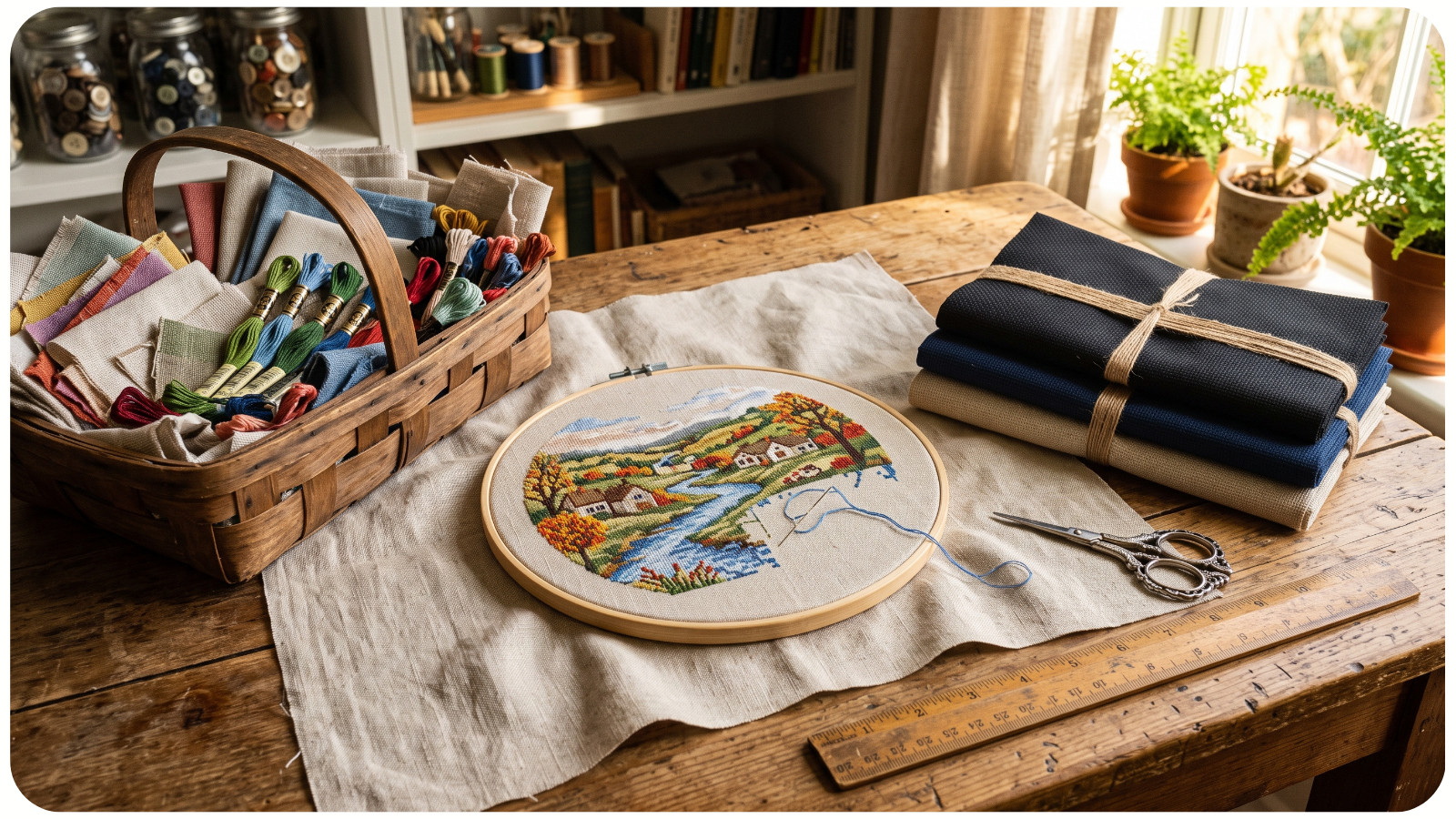
On Aida, the woven thread groups create clear squares. If you work one cross over each square, 14 count Aida gives you 14 crosses per inch. On 18 count Aida, 18 smaller crosses fit into the same space.
On evenweave and linen, the count refers to individual fabric threads. Stitchers can work over one thread or over two:
• 28 count fabric stitched over two has an effective count of 14 stitches per inch.
• 25 count fabric stitched over two has an effective count of 12.5 stitches per inch.
• 25 count fabric stitched over one holds 25 very small stitches per inch.
That is why a design stitched over two on 28 count fabric has the same finished dimensions as the same chart worked on 14 count Aida. If terms such as over one, over two, full cross, and fractional stitch feel unfamiliar, this cross-stitch terminology guide explains the basics.
Count describes density, not fiber content or quality. Fabrics with the same count can still feel different. See our comparison of different types of cross-stitch fabric.
Cross-Stitch Fabric Count at a Glance
The table below compares the most common ways to use each count. Strand numbers are not included because coverage changes with floss, tension, fabric color, and personal preference.
Common cross-stitch fabric counts and their effective stitch density | ||||
Fabric count | Method | Stitches per inch | General result | Often chosen for |
|---|---|---|---|---|
11 count Aida | Over one square | 11 | Large, easy-to-see crosses | Bold motifs, quick samples, easier counting |
14 count Aida | Over one square | 14 | Balanced stitch size and detail | Beginners and many everyday projects |
16 count Aida | Over one square | 16 | Smaller, smoother-looking crosses | More detail without a major jump in difficulty |
18 count Aida | Over one square | 18 | Fine, compact stitching | Detailed designs and smaller finished pieces |
25 count evenweave | Over two threads | 12.5 | Slightly larger than 14 count Aida | Decorative projects and over-two practice |
25 count evenweave | Over one thread | 25 | Very small, dense stitches | Detailed full-coverage work |
28 count evenweave or linen | Over two threads | 14 | Same stitch size as 14 count Aida | A finer surface with a familiar stitch size |
28 count evenweave or linen | Over one thread | 28 | Very fine stitches | Miniatures and experienced over-one stitching |
How the Common Aida Counts Compare
11 Count Aida: Large and Easy to See
Eleven count Aida has large squares and clear holes, which helps when visibility and simple counting matter most.
Bold designs usually suit this count better than charts filled with tiny details or fractional stitches. The same chart will finish larger than on 14, 16, or 18 count. Test floss coverage before starting.
14 Count Aida: The Versatile Starting Point
Fourteen count Aida is a common beginner choice because its grid is easy to follow while still supporting clear detail.
Two strands of cotton floss are a common starting point, but not a fixed rule. Fabric color and tension affect coverage, so make a small test patch when it matters.
Choose 14 count when you want a practical balance of visibility, detail, stitching speed, and finished size.
16 Count Aida: More Detail in Less Space
Sixteen count Aida fits 16 stitches into each inch. Compared with 14 count, the finished width and height are each 12.5 percent smaller.
It is a comfortable next step after 14 count. Curves can look smoother, and a large chart requires less frame space. A coverage sample remains the safest strand guide.
18 Count Aida: Fine and Compact
Eighteen count Aida creates small crosses and a compact finish. It suits detailed patterns, full-coverage designs, and limited frame space.
The holes may be difficult to see in dim light. A task light and good contrast behind the fabric help. Strand count depends on the chart, tension, and desired coverage.
25 and 28 Count Fabric: Over One or Over Two?
Twenty-five and 28 count fabrics are commonly sold as evenweave or linen, although count alone does not identify the type. Here, you count individual fabric threads.
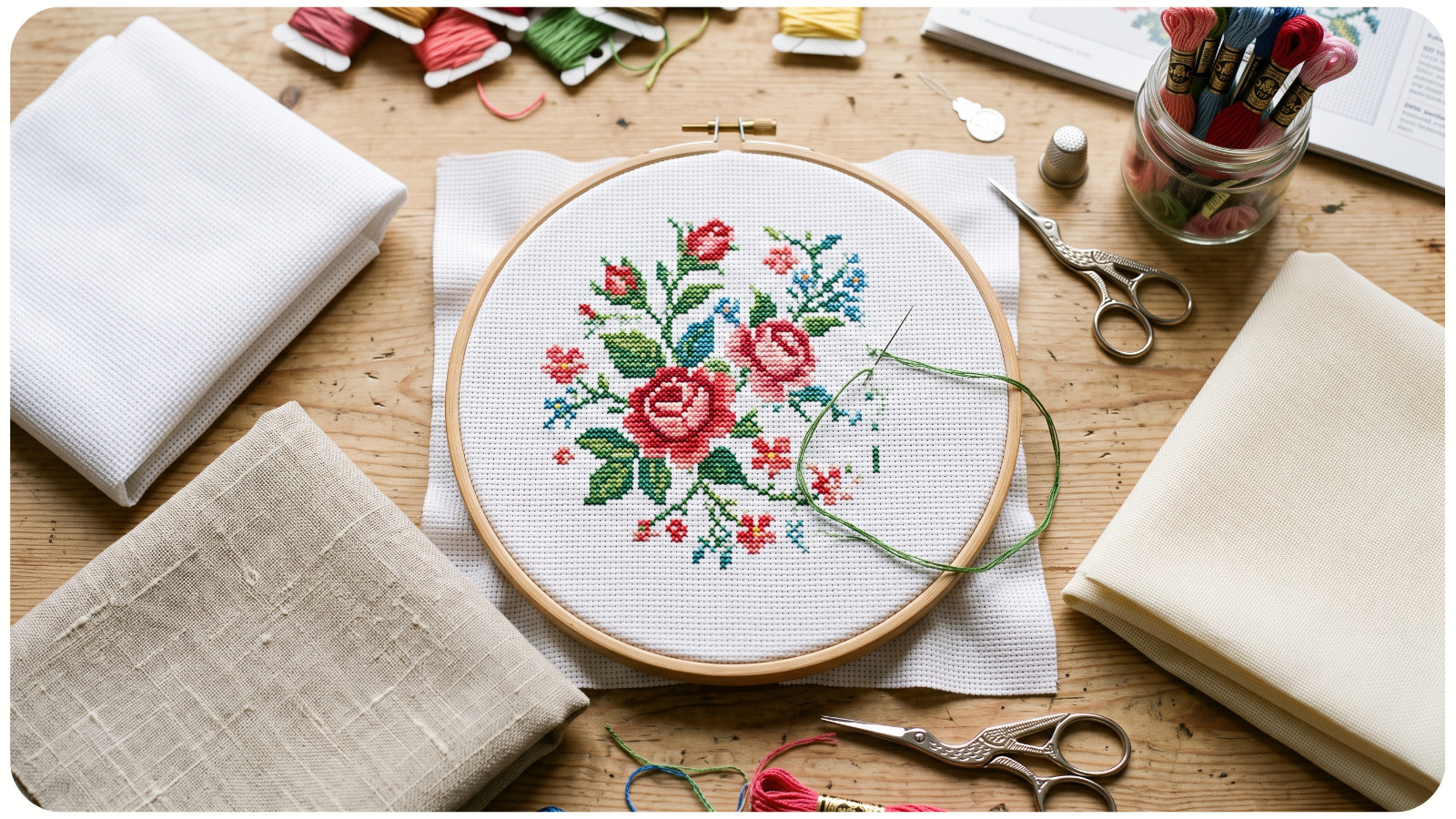
When stitching over two, each cross spans two horizontal and two vertical fabric threads. The intersection in the center also makes quarter and three-quarter stitch placement more direct than splitting the center of an Aida block.
Twenty-eight count stitched over two matches 14 count Aida in stitch size. The chart keeps the same finished dimensions, but the fabric surface and stitching experience are different.
Twenty-five count over two produces 12.5 stitches per inch, so the design is slightly larger than on 14 count Aida. Over one, it produces 25 small stitches per inch and requires careful counting and tension. Our micro cross stitch guide covers very small stitches in more detail.
How Fabric Count Changes the Finished Size
For Aida stitched over one square, divide the chart width and height in stitches by the fabric count:
Chart stitches ÷ fabric count = stitched size in inches
For evenweave or linen stitched over two, first divide the fabric count by two. Then divide the chart dimensions by that effective count.
For example, a 140 × 100 stitch chart produces these stitched dimensions:
Finished size of a 140 × 100 stitch chart | ||
Fabric and method | Finished size in inches | Approximate size in centimeters |
|---|---|---|
11 count Aida | 12.73 × 9.09 | 32.3 × 23.1 cm |
14 count Aida | 10 × 7.14 | 25.4 × 18.1 cm |
16 count Aida | 8.75 × 6.25 | 22.2 × 15.9 cm |
18 count Aida | 7.78 × 5.56 | 19.8 × 14.1 cm |
25 count over two | 11.2 × 8 | 28.4 × 20.3 cm |
28 count over two | 10 × 7.14 | 25.4 × 18.1 cm |
These figures cover only the stitched area. Add fabric around every side for holding, finishing, and framing. Many stitchers allow about 2 to 3 inches per side, but the correct margin depends on the finishing method and your framer's requirements.
For more examples and a complete planning method, use our guide to calculating cross-stitch fabric size.
How to Choose the Best Cross-Stitch Fabric Count
Start with the finished result you want, then check whether the fabric will be comfortable to stitch.
1. Decide how large the design should be. A lower count makes the design larger. A higher count makes it smaller.
2. Check how clearly you can see the holes. If visibility is your main concern, start with 11 or 14 count Aida.
3. Look at the chart's level of detail. A higher count can create a finer surface, but it cannot add details that are not present in the chart.
4. Check for fractional stitches. Evenweave or linen stitched over two can make quarter and three-quarter stitch placement easier.
5. Think about the fabric surface. Fourteen count Aida and 28 count linen over two create the same stitch size, but they look and feel different.
6. Review the finishing plan. Confirm the frame, hoop, ornament, or display size before cutting.
If unsure, sample the pattern's lightest and darkest floss colors. Check them both close up and from a normal viewing distance before choosing your strand count.
Can You Change the Fabric Count in a Cross-Stitch Pattern?
Yes, most counted cross-stitch charts can be worked on a different fabric count. The chart remains the same, but the finished size changes. Recalculate both dimensions and add the correct margin before cutting.
Check for beads, buttons, charms, or other fixed-size embellishments. They do not shrink when count rises and may stop fitting. A count change can also affect floss use, strand count, and framing.
Frequently Asked Questions
Is 14 or 16 Count Aida Better for Beginners?
Fourteen count Aida is usually easier to see and is a comfortable first choice. Choose 16 count if you can see the holes clearly and want a slightly smaller, finer result.
Is 28 Count the Same as 14 Count?
Only when 28 count fabric is stitched over two threads. Both methods produce 14 cross stitches per inch. If you stitch over one thread on 28 count, each cross is half as wide and half as tall as an over-two cross.
Can I Use 14 Count Instead of 18 Count Aida?
Usually, yes. The design will be larger on 14 count. Divide the chart width and height by 14 and check any beads, buttons, or other fixed-size elements before cutting the fabric.
Does a Higher Fabric Count Use Less Floss?
Not automatically. Smaller crosses use less thread per stitch, but strand count, tension, stitch path, fabric thickness, and the distance between color areas also affect floss use. Treat the chart's estimate as a starting point after changing the fabric count.
What Fabric Count Should I Choose?
Choose 14 count Aida as an all-around starting point, 16 count for a finer look, 18 count for a compact finish, and 11 count for large, easy-to-see squares. Choose 25 or 28 count evenweave or linen when you want to stitch over one or over two on a finer fabric surface.
The best cross-stitch fabric count gives your chart the right finished size while allowing you to see the fabric clearly and keep even tension. Calculate the size, test a few stitches, and only then cut your fabric.