


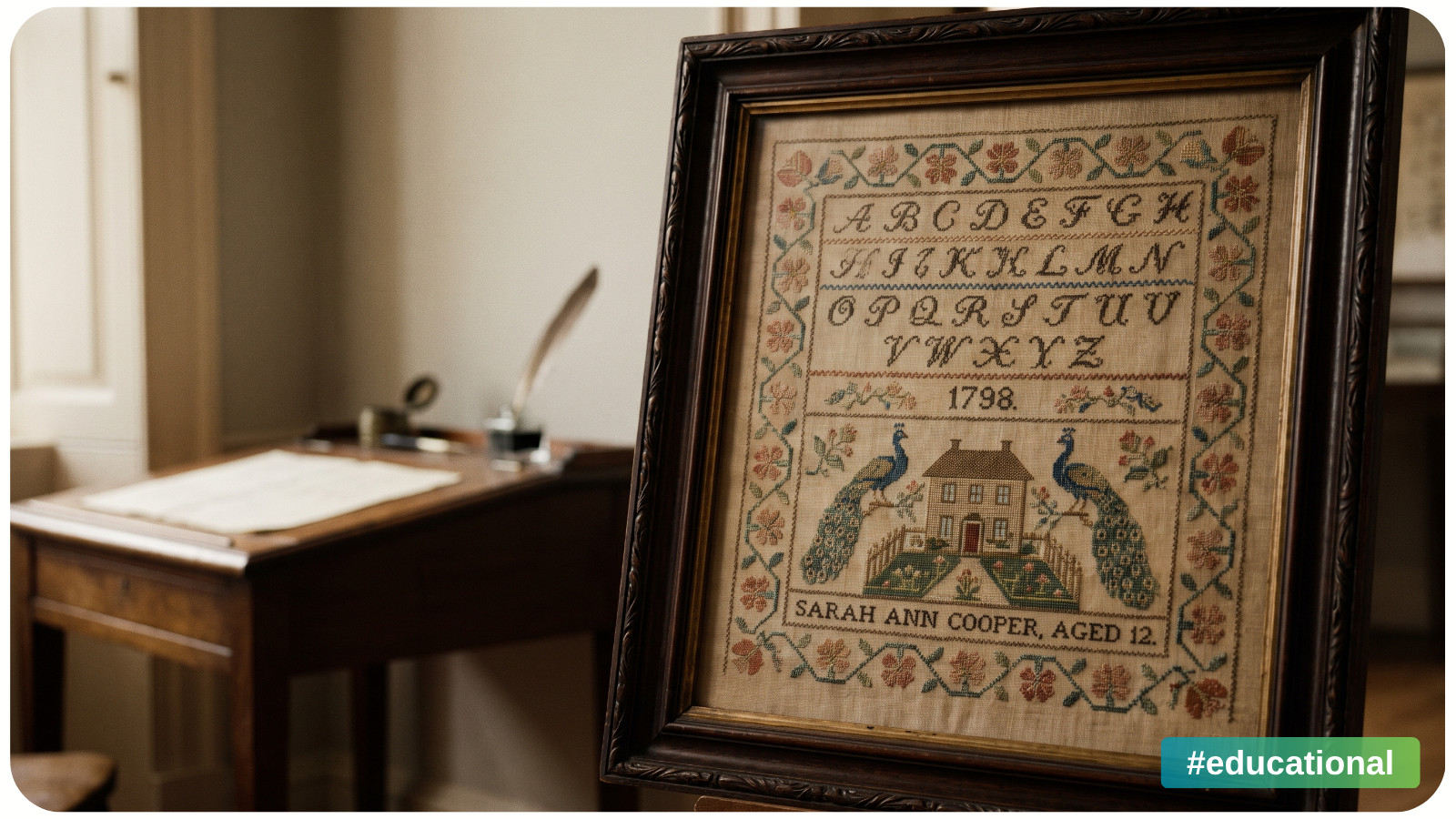
At first glance, an antique sampler may look like a tidy arrangement of alphabets, flowers, borders, and solemn little verses. Look closer, though, and it begins to feel less like decoration and more like a page from someone’s life.
The names stitched into these textiles often belonged to girls whose lives left few other records. Their samplers reveal what they were expected to learn, which values surrounded them, where they went to school, and how their families understood education, work, faith, and respectability. Some record births and deaths. Some map the world. Some stop halfway through a flower. Together, they show that a needle could be a practical tool, a school instrument, and a form of authorship - all at once.
Before the Sampler Became Schoolwork, It Was a Working Archive
The word sampler is related to words meaning “example,” and that was its earliest purpose. Before printed patterns were widely available, embroiderers needed a way to preserve stitches and designs they might want to use again. A length of fabric could become a portable reference library: a border for a cuff, a floral motif for household linen, a lace-like filling stitch, or a small figure copied from another maker.
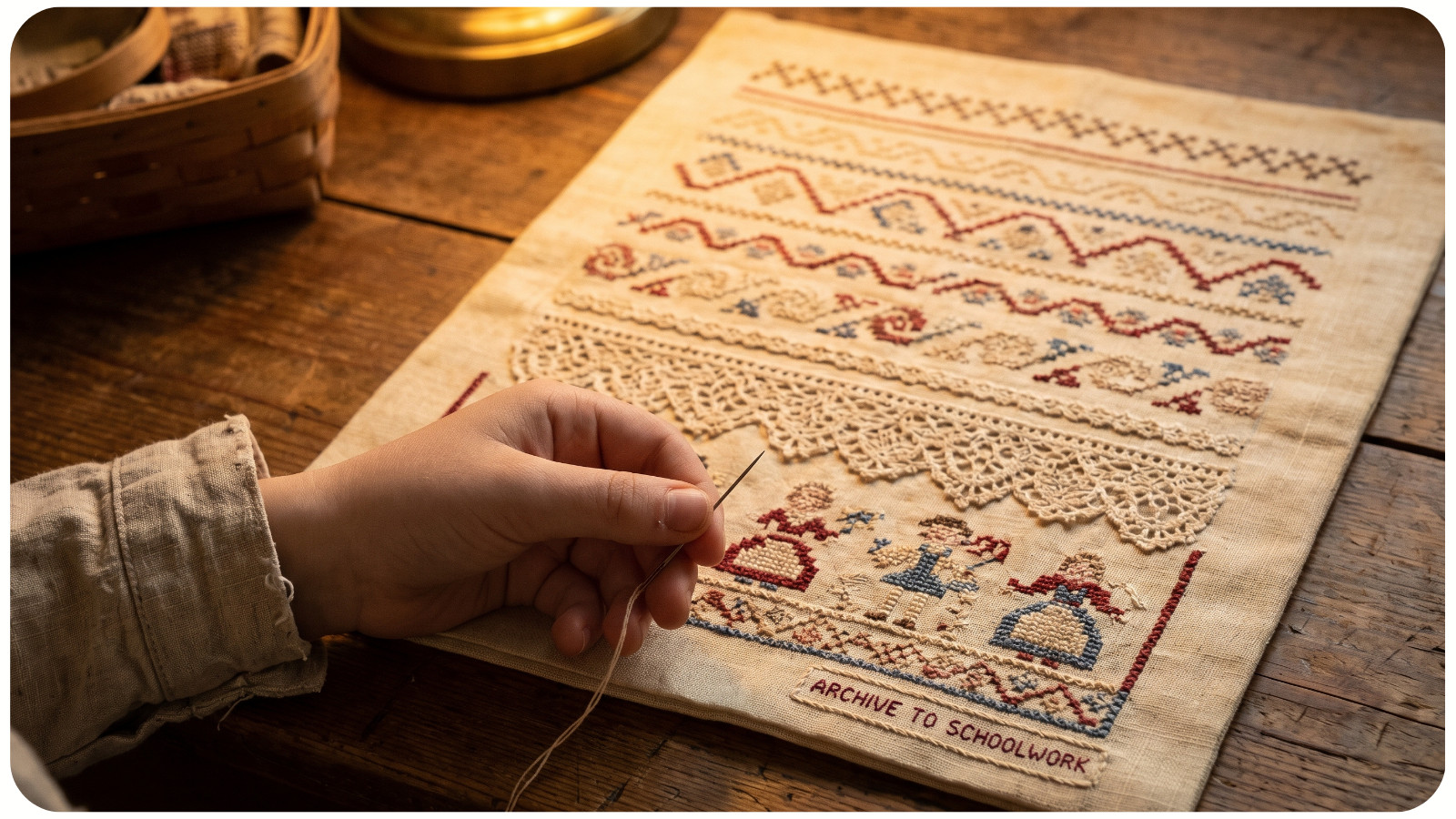
These were not necessarily beginner exercises. Many display highly skilled hands gathering visual knowledge in thread, much as an artist fills a sketchbook. Their legacy echoes in modern sampler cross-stitch patterns, where borders and repeated motifs create a small visual world.
By the seventeenth century in England, however, the sampler was increasingly used to teach girls. Randomly arranged “spot samplers” preserved individual motifs, while long “band samplers” organized patterns in horizontal rows. The fabric still stored useful information, but now it also recorded a student’s progress.
A sampler was no longer only a collection of designs; it became evidence that a girl had learned patience, accuracy, and control of her materials. The cloth displayed both her stitches and the character her society wished to see.
A Girl’s Education Was Written in Thread
For many girls in Europe and early America, sewing was not an optional pastime. It was preparation for the labor of maintaining a household. Clothing and linens needed to be made, marked, repaired, and altered. An embroidered alphabet had an immediate use: initials helped sheets, undergarments, and other textiles return to the correct owner after washing.
Samplers combined needlework with reading, spelling, counting, geography, and religious instruction. Letters and numerals demonstrated literacy; verses praised diligence, humility, obedience, or faith. Map samplers turned geography lessons into stitched outlines. One piece could be a workbook, report card, and graduation project. Today’s numbers-and-letters designs use some of the same visual building blocks in a very different setting.
Martha Edlin’s surviving work shows this education unfolding over time. She completed a band sampler in England in 1668 at age eight. The following year, she added more difficult cutwork and needle lace. She later embroidered a casket and other objects, dating several as if marking stages in her education. Together, the pieces reveal the growth of her hand.
Yet access to this training was unequal. Fine materials, instruction, and time all cost money. A highly finished sampler could advertise a family’s resources as well as a daughter’s ability. Framing one celebrated an accomplishment while presenting an image of education, order, and social standing.
Shared Patterns Still Left Room for Individual Lives
Sampler makers rarely began with complete artistic freedom. Teachers supplied motifs, verses circulated from books and copy sheets, and students often produced variations on a local style. Those similarities can now help historians identify a teacher, school, town, or religious community.
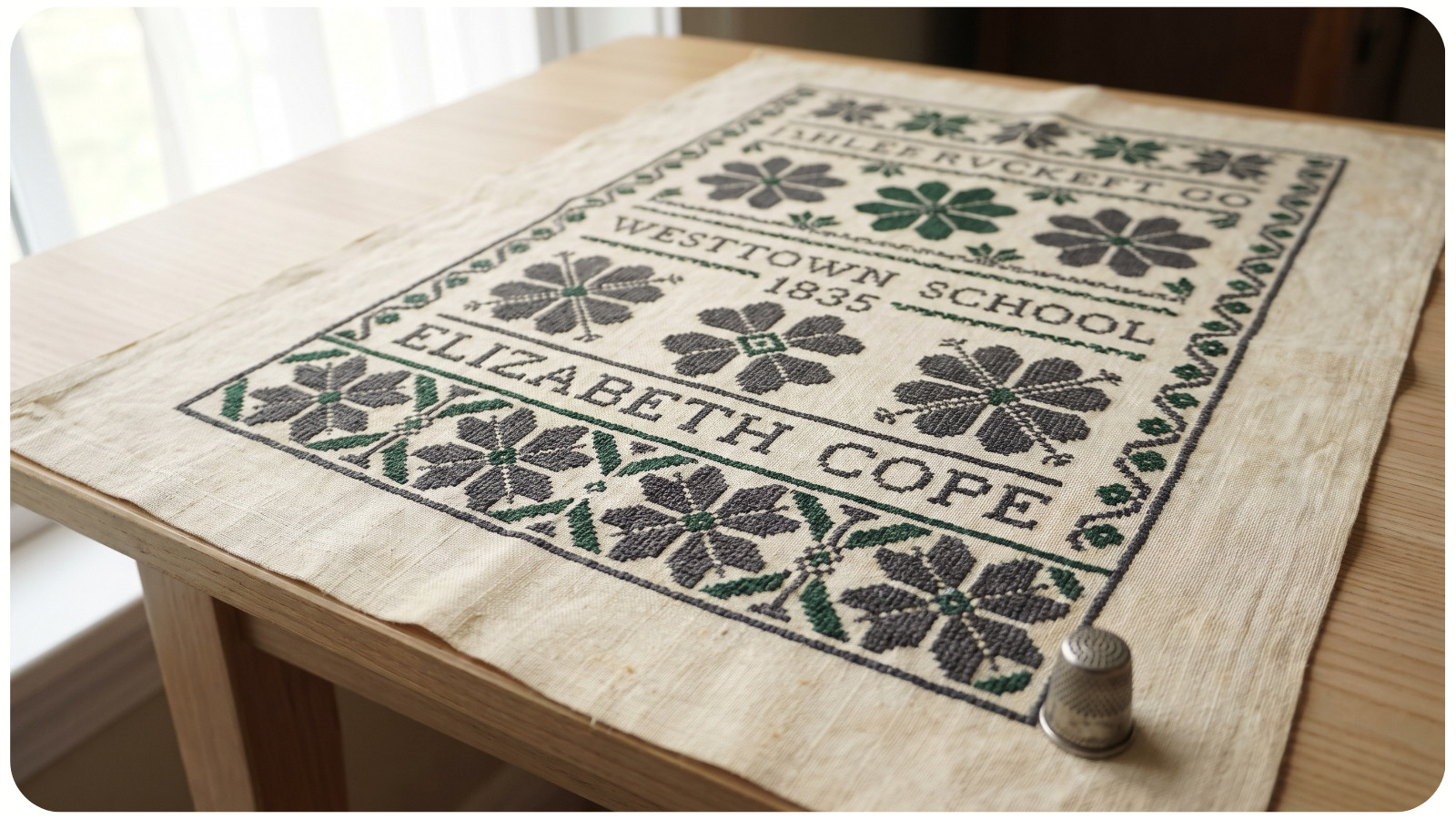
Within those conventions, personal details surface everywhere: a name, age, location, date, family initial, favorite color, or local building. Even an uneven border or unfinished section may suggest that a lesson ended, circumstances changed, or the maker never returned.
Rebecca Marsh’s 1802 sampler, made when she was eleven at the Westtown Quaker School in Pennsylvania, reflects a school culture that valued precise and practical sewing. Polly Platt’s 1809 double-hemisphere map sampler points to a broader academic ambition: girls could demonstrate knowledge of geography while also displaying technical skill. Lydia Pearson’s sampler, completed in Massachusetts in 1802, includes four alphabets, a verse about using time well, and her name, birth date, and age. The message is conventional, but Lydia’s presence is specific.
The result is a fascinating tension. The overall format tells us what a community expected from girls; the choices and irregularities tell us that a particular person was there.
Family Memory Could Become an Official Record
Some samplers moved far beyond the schoolroom. Girls stitched family registers that recorded births, marriages, and deaths at a time when official recordkeeping could be inconsistent. These textiles preserved genealogy within the home, often surrounded by decorative borders, trees, flowers, or mourning imagery.
In a remarkable group held by the U.S. National Archives, samplers eventually entered Revolutionary War pension files. Families submitted them to the federal government as evidence of age, marriage, or kinship. A piece of linen made by a child could, decades later, help establish an adult woman’s legal claim.
Martha Earl, for example, probably stitched her sampler around 1787, when she was about six. It named her, identified Hackensack as her home, and recorded her birth date. More than fifty years later, as a widow, she submitted it in support of her mother’s pension application based on her father’s Revolutionary War service.
What began as a school exercise became a family keepsake and then a government document. That is a lot for one piece of linen to carry. The stitches passed information across generations because someone believed the cloth was worth saving.
Whose Stories Survive - and Whose Are Harder to Find?
It is tempting to speak of “women’s samplers” as though they represent women’s experience as a whole. They do not. The best-known collections are heavily shaped by what institutions and families preserved, collected, documented, and valued. Samplers associated with white, economically secure girls often had a better chance of being framed, inherited, and eventually acquired by museums.
That makes less common survivals especially important. A sampler signed by twelve-year-old Rachel Barrett on December 11, 1845, names the African School in segregated Halifax, Nova Scotia. The Nova Scotia Museum identifies it as a rare sampler connected to the nineteenth-century African Nova Scotian community. It confirms Rachel’s presence in a school whose archival records do not mention sampler making.
Absence from a collection is not absence from history. Materials wore out, storage was uncertain, and institutions overlooked makers. Some girls had little access to formal instruction. Every sampler opens a window, but the view is never complete.
Sometimes the Needle Escaped the Script
Most schoolgirl samplers use approved language: alphabets, scripture, moral advice, and verses about time or mortality. But the act of stitching words could also create space for a more personal voice.
Around 1830, a young English domestic servant named Elizabeth Parker covered a large piece of cloth with lines of tiny red cross-stitch. Instead of a short improving verse, she stitched an extended autobiographical account of distress, mistreatment, religious fear, and survival. Her work uses the disciplined visual language associated with feminine obedience, yet turns it into testimony.
Elizabeth Parker’s sampler is exceptional, and it should not be treated as the secret meaning behind every conventional alphabet. Still, it reveals what the medium could hold. A woman with limited access to ordinary forms of writing could construct a text slowly, one cross at a time. The same technique that fills today’s cross-stitch designs with color once gave her a way to speak.
The Most Human Details Are Not Always the Neatest Ones
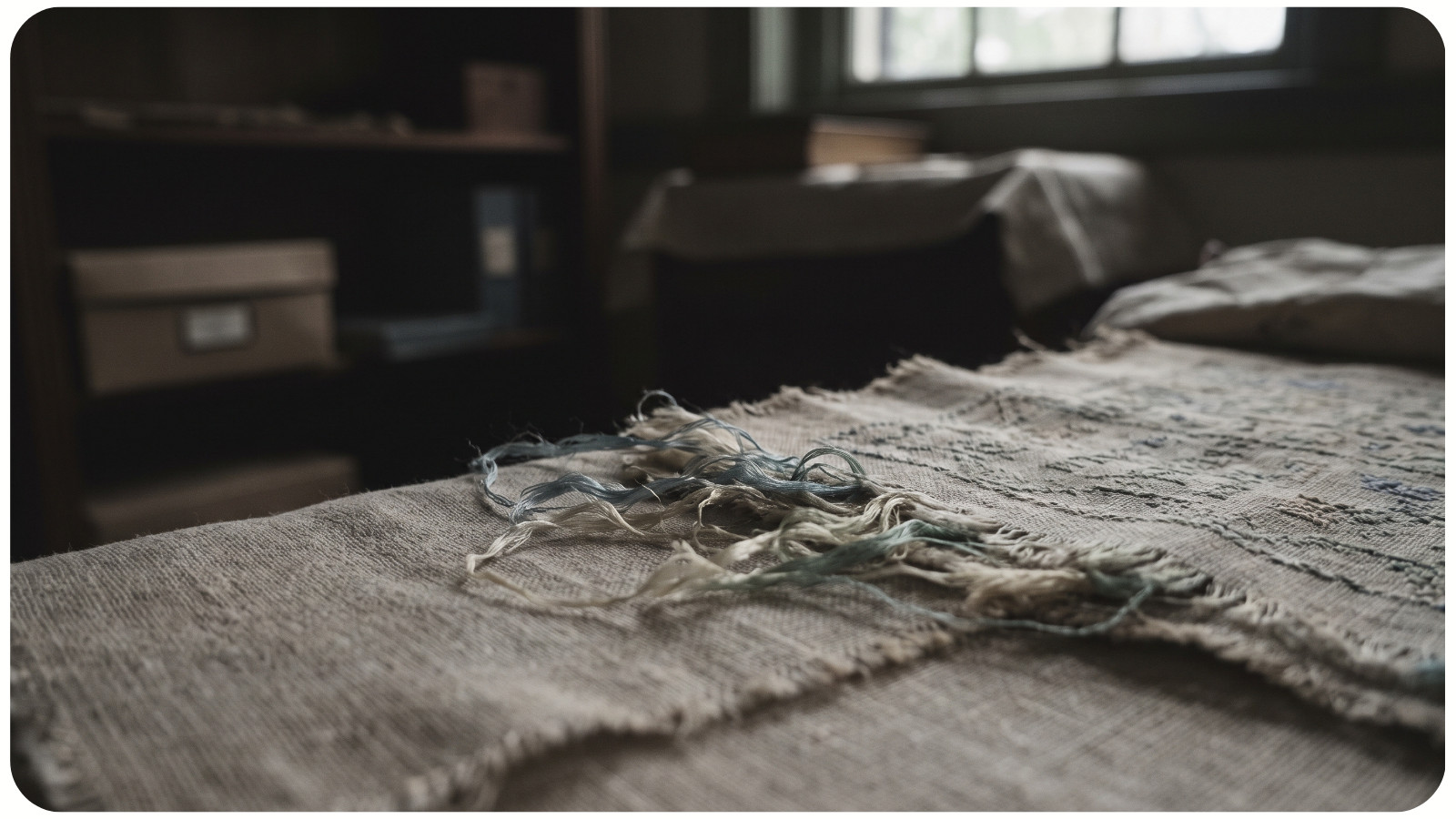
Historic samplers are often admired for symmetry, but their imperfections may bring us closest to their makers. A cramped line shows misjudged space. A reversed letter captures learning. An abandoned bouquet preserves effort without a polished ending. Faded silk, holes, and repairs reveal use and care.
For modern stitchers, this can feel wonderfully familiar. Counting goes wrong. A border refuses to meet. Plans change halfway through. The maker adapts.
That recognition does not erase the distance between past and present. Most historic girls stitched under expectations very different from those of today’s hobbyists. But the physical rhythm of the work creates a point of contact. Each letter required a decision. Each motif consumed time. Each completed row made thought visible on cloth.
The art of the sampler lies in this double life. It is a designed object made from repeated stitches, and it is also a record of education, labor, belief, family, opportunity, and identity. Whether we encounter that visual language in historic textiles or contemporary embroidery patterns, the essential idea still feels powerful: cloth can hold memory. In many cases, a sampler is the one surviving object that carries its maker’s name in her own hand—even when that hand wrote with a needle.